
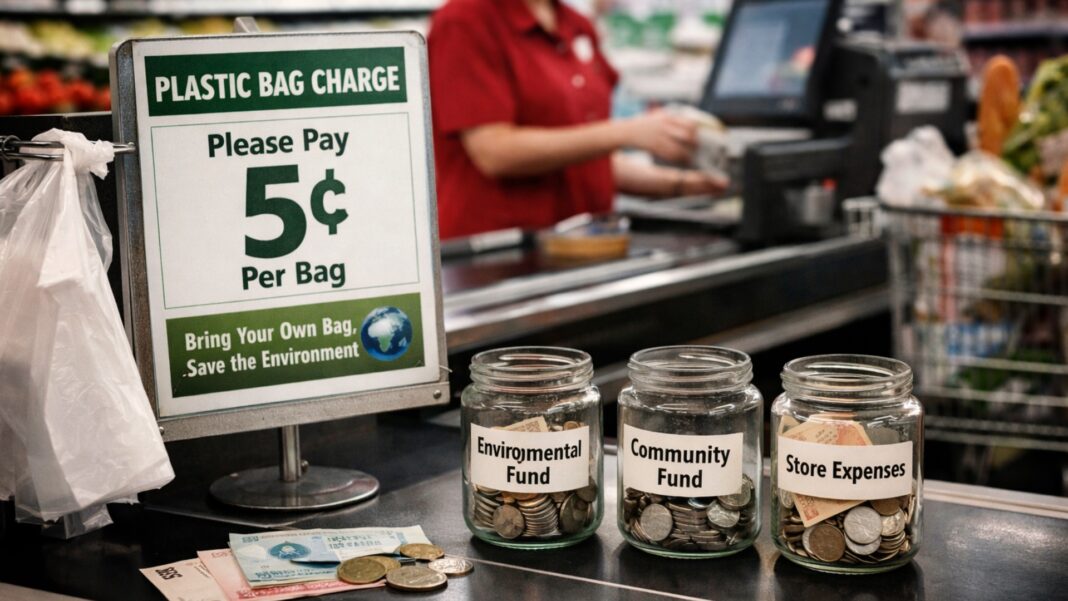

SINGAPORE: More than two years after supermarkets began charging for disposable bags, millions of dollars have been collected. Much of it supports environmental and social causes. Some of it, however, has been returned to supermarket operations. That has drawn criticism from green groups, Channel NewsAsia (CNA) reports.
The Singapore Environment Council (SEC) flagged cases where most of the proceeds were used internally. These included refrigeration upgrades and electric vehicle trials. While such steps may cut emissions, the SEC said they should already be part of normal business practice.
SEC executive director Cheang Kok Chung said that one supermarket chain spent over 80 per cent of its proceeds on upgrading its refrigeration system. Another supermarket spent proceeds on vehicular electrification trials. And although these measures can be seen as helping reduce emissions, they are expected of any business committed to sustainability.
At the extreme end, Hao Mart used almost all the money on its own operating costs, apart from GST. The chain collected S$32,000 in the second half of 2023 and S$21,000 in 2024. Such use of the charges may undermine public support for the policy, Mr Cheang explained.
The plastic bag charge became mandatory on July 3, 2023, for large supermarkets with an annual turnover of S$100 million or more. Each disposable bag must cost at least five cents.
According to the National Environment Agency (NEA), more than S$3 million was collected in the first six months. In 2024, that figure rose to over S$6 million. Supermarkets handed out 129 million disposable bags that year.
Retailers under the scheme include FairPrice, Sheng Siong, Cold Storage, Giant, Prime Supermarket, Don Don Donki, and Phoon Huat. Hao Mart and Ang Mo Supermarket later fell below the turnover threshold but still charged for bags.
Operators must publish how much they collect and how they spend it. Donations are encouraged but not required. CNA’s review found wide differences in how the money was used.
FairPrice collected the most. It raised S$1.68 million in late 2023 and S$3.41 million in 2024. About half went to the FairPrice Foundation for social programmes. The rest supported electric vehicle infrastructure, packaging reviews, and donations to WWF-Singapore.
Sheng Siong raised over S$2.3 million across the same period. Most of it went to the President’s Challenge. A small share supported the Garden City Fund.
Cold Storage and Giant collected about S$1.55 million over two years. Most of it funded refrigeration upgrades. Smaller amounts went to community events like Chingay.
Other chains focused more on donations. Don Don Donki split its proceeds between Zero Waste SG, The Food Bank Singapore, and Food from the Heart. Prime Supermarket channelled most funds to grassroots and community causes.
Marks & Spencer, added to the scheme in 2025, had no public report at the time of CNA’s review.
Retailers defended internal spending. Cold Storage said its upgrades were aimed at speeding up energy savings. FairPrice said it had reinvested heavily in community efforts and sustainability education, including a S$3 million pledge to support The Carbon Gallery.
Hao Mart said business losses drove its decision. Its senior vice-president, Jupri Suep, said the company is discussing the issue with NEA.
The debate goes beyond accounting. A Nanyang Technological University (NTU) economist, Professor Euston Quah, warned that charging for bags already shifts costs to shoppers. If the money then reduces business expenses, consumers may be boosting profits instead. He added that if part or all of the proceeds were used to reduce firms’ operational costs, it would be a clear case of consumers directly increasing firms’ profits.
Another academic pointed to public trust. Assistant Professor Sreeja Nair of the Lee Kuan Yew School of Public Policy said acceptance depends on whether shoppers see the charge as fair and meaningful. “If sustainability and societal well-being are perceived as distant or abstract goals for the public, the rationale for the disposable carrier bag charge may not fully resonate,” she said.
The bag fee was meant to change habits, not balance books. As collections grow, how the money is used may matter as much as why it was charged in the first place.
 Follow Google News
 Join us on WhatsApp
 Follow us on Telegram