
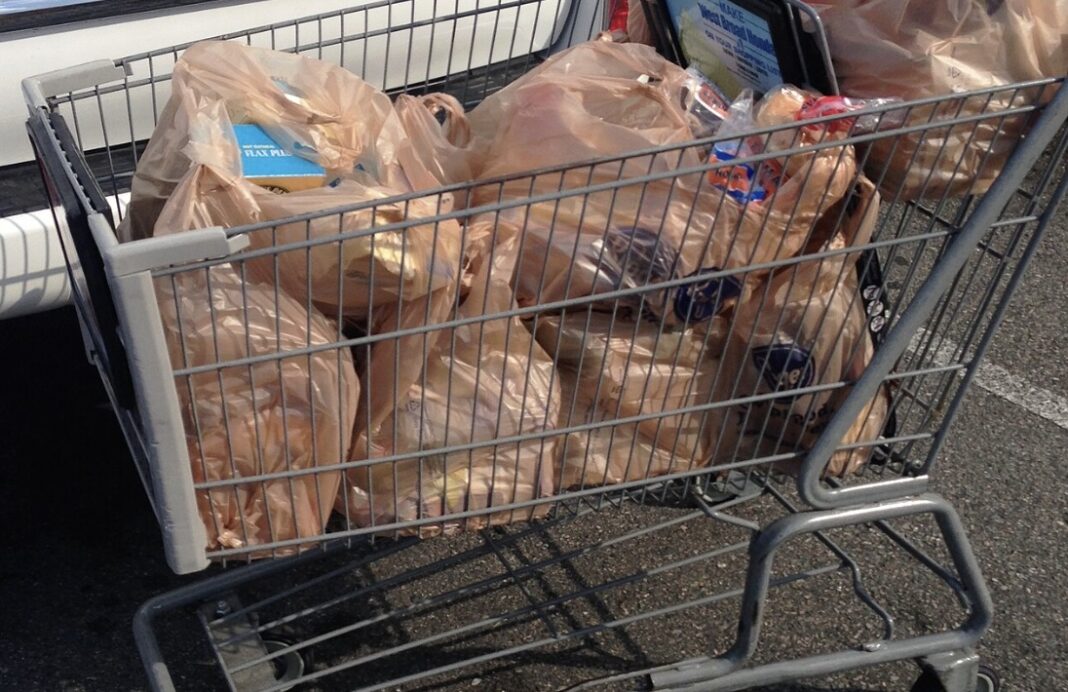

SINGAPORE: Two grocery chains that used to charge shoppers for the plastic bags they used will no longer need to do so.
Since July 2023, Singapore’s bigger grocery store operators, such as NTUC FairPrice, Cold Storage, Giant, Sheng Siong, and Prime Supermarket, have been required to charge at least S$0.05 for each disposable carrier bag that shoppers use.
This regulation was imposed on supermarkets that had an annual turnover of more than S$100 million. Dr Amy Khor, who was the Senior Minister of State for Sustainability and the Environment at the time, said that 400, or two-thirds, of all supermarkets in Singapore, would be charging for all types of disposable carrier bags.
However, the National Environment Agency (NEA) told CNA on Friday (Jan 30) that HAO Mark and Ang Mo Supermarket, have been deregistered from the disposable carrier bag charge scheme, the first time this has happened to an establishment of this type.
After they applied to be deregistered, both were removed from the original list of grocery operators required to impose plastic bag charges in late 2025, since neither HAO Mart nor Ang Mo Supermarket met the S$100 million turnover for the past three years.
NEA has also said, however, that while HAO Mart and Ang Mo Supermarket are no longer required to charge suppers for the plastic bags they issue, they may choose to do so at their discretion.
The grocery operators were encouraged by the government to donate proceeds from the bag charge to environmental or social causes.
CNA reported that HAO Mart was able to collect S$21,143.50 from the sale of 422,870 plastic bags in 2024. The company paid S$1,745.79 in Goods & Services Taxes for the bags, but no other funds were donated. Ang Mo Supermarket, meanwhile, was able to collect S$33,241.40 in 2024 for 664,828 bags, of which S$2,745.92 went to GST.
The rest of the money was given to the Marymount and Punggol Shore Citizens’ Consultative Committee Community Development and Welfare Fund – Education Fund, CNA said.
The push to charge shoppers for plastic bag was part of a move to reduce plastic waste.
“The charge prompts us to consider how many bags we really need. It is intended to nudge us to bring our own reusable bags and reduce the use of disposables.
Whether they are made of paper, plastics, or biodegradable materials, disposables have an impact on our environment during their production, transportation, and disposal. The consumption of disposables generates waste and carbon emissions, worsening the climate crisis.
The disposable carrier bag charge is an important step in our journey towards a Zero Waste Nation. It forms part of our efforts to reduce packaging waste, a priority waste stream under the Zero Waste Masterplan,” reads the NEA website. /TISG
 Follow Google News
 Join us on WhatsApp
 Follow us on Telegram