
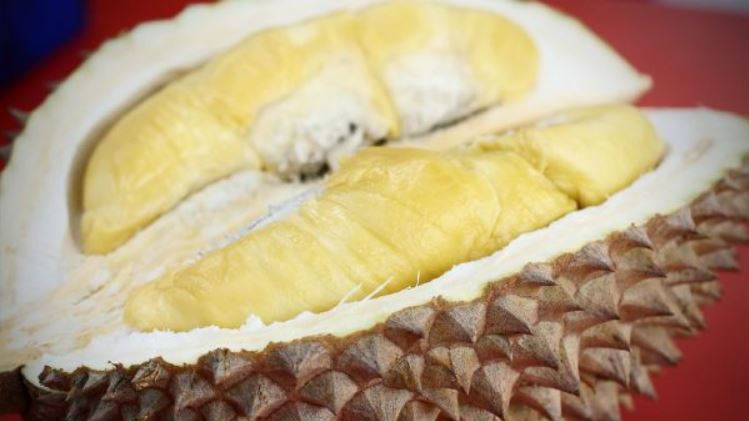

SINGAPORE: After a tourist from China ate a durian in a local hotel, she was allegedly slapped with a S$200 cleaning fee. The woman took to Xiaohongshu, widely regarded as China’s equivalent to Instagram, earlier this week to warn others so that they don’t end up making the same costly mistake.
Commenters have said, however, that she should have known better in the first place, especially as signs abound saying that durians are not allowed in certain places, such as on public transport.
The tourist, who goes by @幽蓝桑 (Blue Mulberry) on Xiaohongshu, posted a video on Monday (May 26). In it, she recounted that she and a friend had bought durian from a vendor’s stall the day before.
They could not eat the fruit at the stall, as there was no seating in the area. Therefore, after the vendor packed up the fruit in a styrofoam box, they took it back to the hotel to eat it there.
On the taxi ride back to the hotel, the post author’s friend remarked that she could smell the fruit, despite it being in the box. Out of concern for the taxi driver, 幽蓝桑 tied the plastic bag more tightly around the box.
The cabby said nothing about the smell, and the post author added that she was able to enjoy the fruit at the hotel later that night.
The next day, after she returned to the hotel from a tour around Singapore, Ms. Fang discovered a letter that the hotel management had left in her room. She was informed that the housekeeping staff had detected the smell of durian in her room, for which the hotel would charge a S$200 cleaning fee.
She said in her video that she and her friend were stunned at the charge and could hardly believe it.
A screenshot of the letter from the hotel shows that it reads, “Please be informed that our Housekeeper found durian smell in your room. We would like to gently inform you that a S$200 will be imposed for a cleaning fee.”
“S$200 is about 1,000 RMB,” she said in her video.
She then went online to see whether others had been in her situation and found out that many people, like herself, were unaware that they were not allowed to bring durian into their hotel rooms.
While she acknowledged to the staff that she had been wrong in bringing and eating durian into her room, she asked for a discount on the cleaning fee, having found out that other tourists had been successful in getting this fee waived. The hotel, however, stood firm, telling her they needed to engage professional cleaning services and that the room would not be usable for some days until the pungent smell of durian dissipated. She ended her video with a warning to tourists not to do as she did.
Netizens, however, said that the tourist could have used some common sense.
“Tourist was not ‘fined,’ a cleaning fee of S$200 was imposed, to make the room ‘stayable’ for the next guest,” one wrote.
“Is she travelling for the first time? Other hotels in the region also prohibit durian in their rooms,” another asked.
“Upon arrival at Changi Airport, all passengers are greeted with clear visual signages and multimedia displays outlining key local laws—no smoking in prohibited areas, no durians in public transport or certain premises, no spitting, no littering, mandatory toilet flushing, and prohibition on chewing gum importation.
Read also: Bill Gates spotted trying out durian during Singapore visit
 Follow Google News
 Join us on WhatsApp
 Follow us on Telegram