
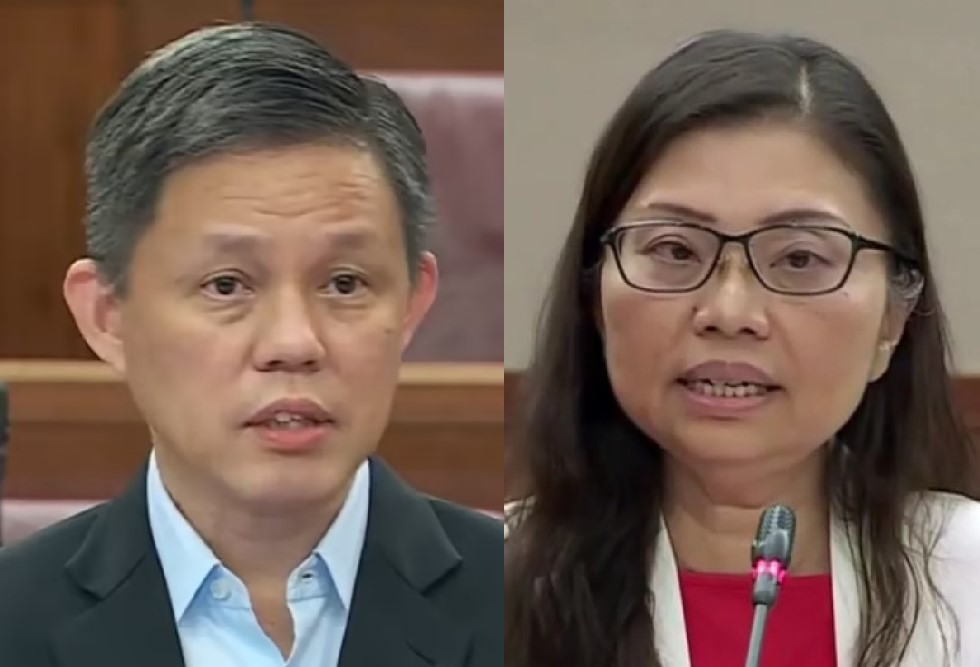

SINGAPORE: Parliament rejected yesterday (5 July) a motion put forth by the Progress Singapore Party (PSP) calling for the elimination of the group representation constituency (GRC) system.
During the debate, Education Minister Chan Chun Sing argued that supporting the motion would carry the risk of insufficient multiracial representation in Parliament and contradict the core principle of ensuring the interests of minority communities are adequately represented.
Asserting that endorsing the motion would leave the emergence of racial politics to chance and hinder the ongoing progress toward a system where electoral contests are not determined by race, he said:
“Our system is not perfect, but it generally produces the desired results, a harmonious and stable society, a well-run political system, a cohesive society, and a parliament that does not discriminate between races.”
PSP non-constituency MP (NCMP) Hazel Poa pointed out that MPs in GRCs have resigned due to various reasons, such as death, and inappropriate behaviour, with some even vacating their elected seat to stand for the presidential election.
However, in all these cases, there have been no by-elections to fill vacancies in Parliaments – even if the MP that has left is a minority MP.
Ms Poa highlighted the case of Senior Minister Tharman Shanmugaratnam, who recently announced his retirement from politics to contest the looming Presidential Election, following the footsteps of current President Halimah Yacob, who did the same in 2017.
No by-elections arose due to both vacancies, even though Mr Tharman is the minority MP for his Jurong GRC.
Asking whether the MPs who were voted into Parliament at Jurong GRC would have made it if it weren’t for Mr Tharman, a veteran politician, anchoring them at the polls, Ms Poa likened Mr Tharman’s resignation to two parties signing a contract, one of whom unilaterally modifies the terms, while the other party is still restricted by the contract before it expires.
The NCMP asserted that this is unacceptable under any circumstances.
Ms Poa suggested two alternatives to the GRC system: a scheme that appoints minority candidates with the highest percentage of votes as NCMPs in the event of under-representation and adopting some form of proportional representation.
Mr Chan questioned the efficacy of the NCMP scheme for minorities, highlighting the potential lack of minority candidates in an electoral system with only single seats.
He also said that Ms Poa’s proposal could lead to a predominantly Chinese party in power with minority MPs in opposition or as NCMPs, creating a dangerous political divide along racial lines.
Regarding proportional representation, Mr Chan expressed reservations about forming parties based on race, religion, or special interests rather than appealing to a broad majority of voters.
Mr Chan added that while Singapore learns from other countries’ experiences in designing its systems, it does not blindly replicate them, especially when those systems face challenges in addressing their issues.
Highlighting the fundamental objectives of the GRC system, which are to ensure that Parliament reflects the racial diversity of society and prevent the politicization of race, Mr Chan argued that Ms Poa’s suggestion would not effectively prevent the latter.
He defended the system’s prevention of a single member holding the rest of the team hostage by threatening to step down. He suggested that both incumbents and opposition parties could benefit from the “star power” of their candidates.
During the debate, Nominated MPs Raj Joshua Thomas, Janet Ang, and Mark Chay expressed their opposition to the motion and said that GRCs help Singapore’s social fabric and promote racial harmony.
 Follow Google News
 Join us on WhatsApp
 Follow us on Telegram