// Adds dimensions UUID, Author and Topic into GA4
Tuesday, June 23, 2026
27.2 C
Singapore

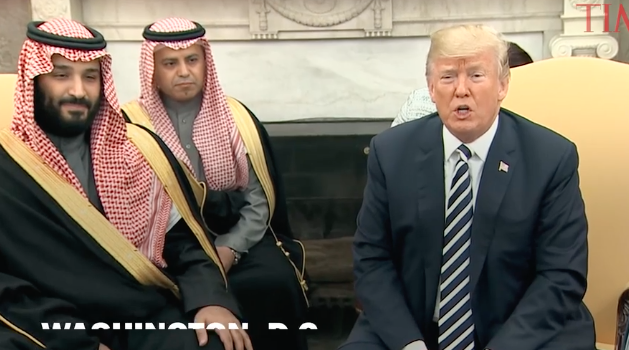
Saudi Crown Prince wants U.S. pressure on Iran maintained to avert war

Saudi Arabian Crown Prince Mohammad bin Salman called on the international community (the U.S. basically) to continue pressure Iran economically and politically.
He said Iran should be pressed with regards to the nuclear agreement to avoid a direct military confrontation in the region.
He said this during an interview with The Wall Street Journal on Friday.
He said he believed sanctions will deter Teheran and to avoid a military conflict in the region caused by Iran.
“Sanctions will create more pressure on the Iranian regime,” the Saudi Crown Prince said.
Iran has supplied the Houthi militia in Yemen with weapons used against Saudi Arabia over the past three years, the crown prince explained during the interview.
Since the war in Yemen began, the Houthi militia group fired several ballistic missiles into Saudi Arabia.
In response to a question on Saudi Arabia’s intervention, the crown prince said: “Yemen was about to get split between the Houthis and Al-Qaeda if we had not intervened in 2015.

During his trip to the U.S., the Saudi Crown Prince Mohammed bin Salman said he wants the U.S. military to maintain a presence in Syria.

Despite President Donald Trump’s declaration that American forces will be pulled from the war-torn country in the near future, he insisted they should not do so.

“We believe American troops should stay for at least the mid-term, if not the long-term,” he told TIME Thursday in a wide-ranging interview.

Bin Salman, who is midway through a multi-city tour in the United States, said the American troop presence inside Syria is the last effort stopping Iran, Saudi Arabia’s arch-enemy, from continuing to expand influence with regional allies. U.S. forces inside the country also allow Washington to have a say in Syria’s future, he said.

Iran, through proxy militias and regional allies, will establish a overland supply route that leads from Beirut through Syria and Iraq to Tehran, Bin Salman said. The so-called “Shiite Crescent” would give Iran a greater foothold in a tumultuous region through a string of allies.

The U.S. maintains a remote base at Deir Ezzor in eastern Syria, in the middle of that corridor. It’s there that Special Operations forces coordinate with Syrian opposition fighters to wipe out the remaining ISIS fighters holed up in a series of towns along the Euphrates River and a stretch of desert straddling the Iraq-Syria border, said Time.


- Advertisement -

Hot this week

Singapore ranked 2nd in global AI workforce adoption, yet leaders lag in strategic AI implementation—Microsoft’s 2026 Work Trend Index says

While 78% Singapore AI users recognise the urgency of adapting to AI fast, only 24% believe their leadership teams are aligned on AI strategy

‘So proud of him’: Singaporeans praise local uni-reject who delivered speech at Harvard Medical School

Tan grew up in Singapore, where he was discouraged from studying biology and faced academic difficulties in high school. He left Singapore and was accepted to the University of Toronto, where he di...

Popular Categories

document.addEventListener("DOMContentLoaded", () => { const trigger = document.getElementById("ads-trigger"); if ('IntersectionObserver' in window && trigger) { const observer = new IntersectionObserver((entries, observer) => { entries.forEach(entry => { if (entry.isIntersecting) { lazyLoader(); // You should define lazyLoader() elsewhere or inline here observer.unobserve(entry.target); // Run once } }); }, { rootMargin: '800px', threshold: 0.1 }); observer.observe(trigger); } else { // Fallback setTimeout(lazyLoader, 3000); } });
// //
Enable Notifications OK No thanks
