

Summary
- Singapore residents are projected to spend an extra S$1.05 billion yearly in Johor Bahru after the RTS Link opens in January 2027.
- Johor Bahru visitors are expected to spend S$756 million more in Singapore each year, resulting in a projected net outflow of S$290 million.
- Grocery, drugstore, food and beauty businesses are expected to face the strongest pressure from increased cross-border spending.
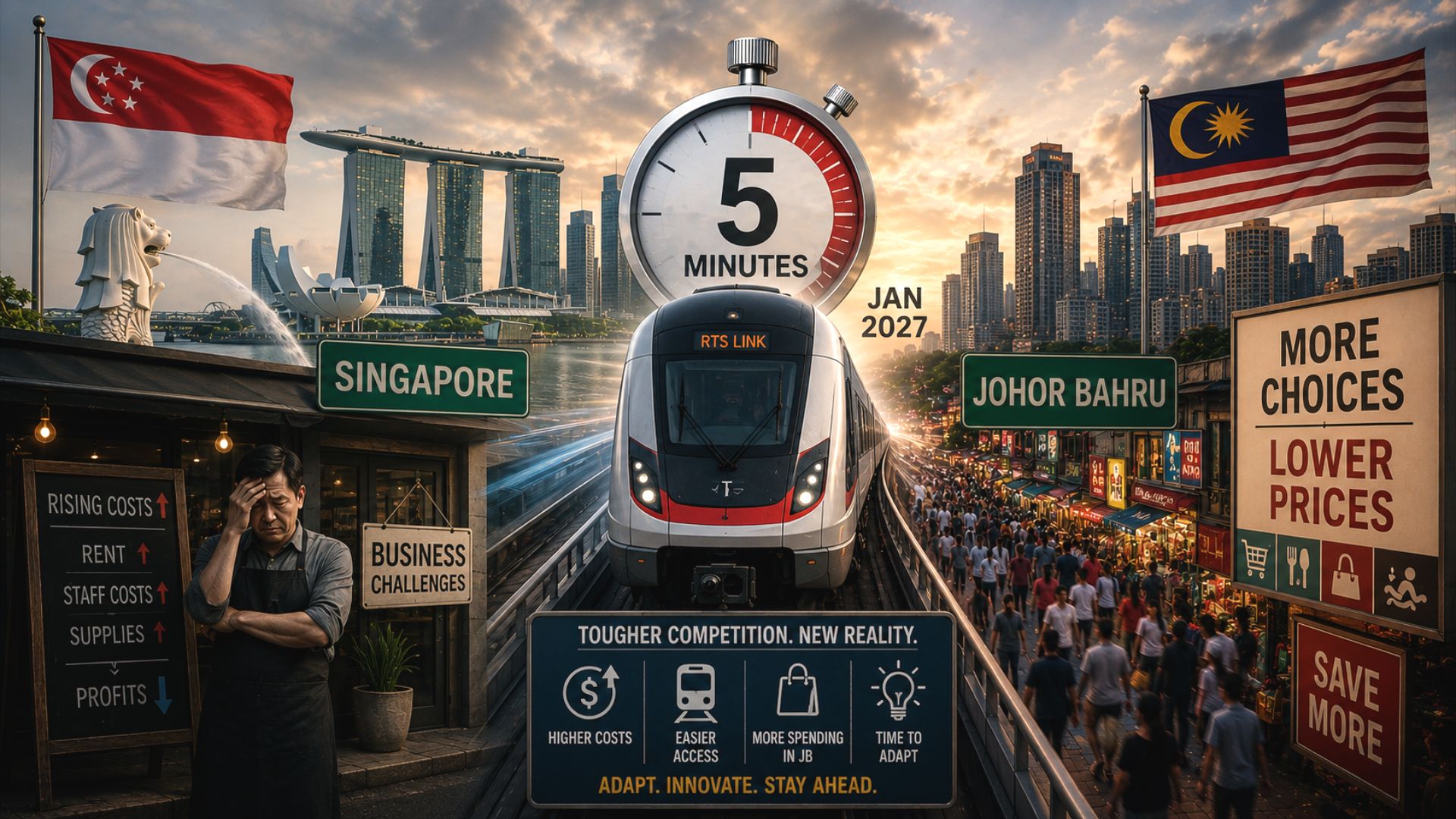
SINGAPORE: A five-minute train ride to Johor Bahru could change how Singaporeans shop, eat, and spend really soon. This is the concern facing many local merchants as the JB-SG Rapid Transit System (RTS) Link prepares to open in January 2027.
The warning is strongest among businesses already feeling the pull of lower prices across the Causeway. Some shoppers are already making regular trips to Johor Bahru for groceries, meals and personal services. And the upcoming new rail link could make those trips far easier.
A study commissioned by the Singapore Business Federation, the Restaurant Association of Singapore, and the Singapore Retailers Association shows that Singapore residents will spend an additional S$1.05 billion each year in Johor Bahru.
Johor Bahru visitors are also expected to spend more in Singapore, but the projected amount is smaller at S$756 million. This leaves Singapore with a projected increase in net outbound spending of S$290 million each year.
It sounds like a large number. However, against Singapore’s total retail and food-and-beverage sales in 2025, it represents 0.4 per cent. The number may be manageable at the national level, but the picture looks different for a small shop trying to hold onto its customers, Channel NewsAsia (CNA) reported (Aug 7).
Lower prices in Malaysia are already sending Singapore shoppers up north
Ruth Lee, a 55-year-old financial adviser, already drives to Johor Bahru every week or two. She visits for breakfast and groceries, saying she can save between 30 and 50 per cent compared with spending in Singapore.
Driving there can be troublesome because of traffic and the need to coordinate the family car. The RTS Link could soon remove much of that friction.
A five-minute train journey between Woodlands and Bukit Chagar would make spontaneous trips much easier. A customer who once needed to plan a cross-border trip around traffic may soon be able to make the journey with much less effort.
Kacey Lin, 50, owns Dawn Beauty at 888 Plaza in Woodlands. Her salon provides nail services, facials, and massages. She said her business has already lost customers to Malaysian competitors because of rising costs in Singapore.
The RTS Link makes future business growth harder to predict. Wong Toh Onn, 70, who works at a minimart in Bukit Batok East, said his business has fallen by about 20 per cent over the past two years.
Customers have told Mr Wong that they are buying groceries in Johor Bahru more frequently due to higher living costs and the favourable exchange rate.
The business owner’s reaction to the coming-soon rail link captured his deepest worries: “When the train opens, we’re doomed.”
Mr Wong’s problem is similar to many other small retailers. Keeping prices low becomes harder when rent, manpower and supply costs rise, leaving merchants squeezed between higher costs at home and cheaper alternatives across the Causeway.
Small businesses could feel the impact first
The commissioned study found that groceries and food products could see the largest net increase in outbound spending. Drugstores, F&B businesses, and beauty services are also expected to face strong pressure.
Northern Singapore could feel the effect more sharply because of its proximity to the RTS Woodlands North station. The study found that the northern region already had stronger outbound spending before the RTS Link opens.
That gives the rail link a very direct local impact. The concern extends beyond individual shops. Singapore has about 24,500 retail enterprises, with 98 per cent classified as micro or small businesses, according to the report.
Ang Yuit, president of the Association of Small and Medium Enterprises, said shop closures could affect suppliers, logistics firms and workers connected to these businesses. This is where a retail problem can become a wider business problem.
Analysts also warned that if enough small neighbourhood businesses disappear, Singapore could lose some of the independent shops that give different areas their own character.
The RTS Link, however, isn’t the cause of all these problems. It just exposes weaknesses that are already there.
Singapore merchants are dealing with higher rents, manpower costs and supply expenses while competing with businesses in a nearby market that benefits from the exchange rate. The train simply makes that competition easier to access.
Vouchers can help, but businesses need bigger changes
The study proposed 11 recommendations covering domestic spending, tourist spending, and business adaptation. Some measures involve temporary cost assistance, including expanding Community Development Council vouchers and providing targeted manpower levy relief and wage support.
Such support could give struggling businesses some breathing room. Lawrence Loh, director of the Centre for Governance and Sustainability at the National University of Singapore Business School, said subsidies alone can’t solve the deeper cost problem.
Lee Kuan-Huei, an associate professor at the Singapore Institute of Technology, also said long-term policies are needed because the RTS Link is permanent, as businesses need help to improve productivity, change their models, and find new ways to compete.
The government has been preparing for this. A task force was set up in March 2025 to study how Singapore businesses could benefit from opportunities created by the RTS Link.
Gan Kim Yong, Deputy Prime Minister and Minister for Trade and Industry (Trade), said in written parliamentary replies that the government recognises the increasingly competitive environment facing businesses. The task force is expected to share its findings and recommendations later this year.
Competing on service instead of price
Some Singapore businesses already know they can’t win a price war with Johor Bahru. Their answer is to give customers reasons to stay.
Kacey Lin said customers who have tried beauty services in Malaysia have told her that her salon’s manicures are cleaner and more durable, giving her own business something to build on.
Terence Fan, assistant professor of strategy and entrepreneurship at Singapore Management University, said businesses should also explain differences between similar products sold in different markets.
Even products carrying the same brand name can sometimes be made in different factories or use different formulations, as businesses need to make their value easier for customers to see.
Convenience is another advantage. Perky Lash founder Jasmin Tay, 41, began offering home visits for lash and nail services in April.
Their service targets customers who prefer to have treatments done at home after work while staying with their children. About half of her clients have tried or arranged to try the service, according to her estimate.
The idea is that instead of asking customers to travel to the business, the business travels to them; the kind of convenience is difficult to compare on a price chart.
Some merchants are changing what they sell
Other businesses are changing their products and pricing to reduce the temptation of crossing the Causeway.
Samuel Pei, 45, co-founder of KC Group, said the company has been reviewing its beauty brands and focusing more on smaller services with narrower price differences.
A simple haircut is one example. If the difference between a haircut in Singapore and Johor Bahru isn’t large enough to justify the journey, convenience can win.
Other businesses are working on their operations instead. Automation and better processes can reduce manpower needs and lower costs over time.
British Essential chief executive Christopher Lim said his company is also working with suppliers to improve operations and expand its exclusive product range.
Major supermarket chains are taking similar steps through retail technology, automation, productivity programmes, and changes to their product mix.
Woodlands could turn its location into an advantage
The northern region faces a tough test, but its location could become one of its biggest strengths.
Nanyang Polytechnic senior lecturer Lee Gek Keow suggested that businesses and mall operators could work together to make Woodlands a stronger destination.
Dining clusters, weekend events, community festivals, thematic markets, and shared loyalty programmes could give people more reasons to spend time there.
Lawrence Loh of NUS also suggested building event facilities and surrounding them with carefully chosen businesses, which could turn Woodlands into more than a place people pass through on their way to Johor Bahru.
The planned Woodlands Gateway district could add to that transformation. The Ministry of Trade and Industry announced the mixed-use district in March 2026. It will be built around the RTS Link station and include commercial, lifestyle and transport facilities.
The first phase is expected around 2030, with the district covering an area equal to about 50 football fields. The challenge is making Woodlands worth stopping for because a convenient train station alone can’t do that.
Singapore also needs reasons for visitors to come south
The spending flow won’t move in only one direction. The study expects Johor Bahru residents to spend more in Singapore too, with Central Singapore expected to capture much of that spending.
Orchard Road and Marina Bay already have major retail, hotels, dining, concerts and attractions concentrated in one area. Replicating that elsewhere would be difficult.
A more practical approach could be for different neighbourhoods to build their own identities. Woodlands could develop its own identity rather than trying to copy Orchard Road.
A northern lifestyle and entertainment district could also give Johor Bahru visitors another reason to cross into Singapore without travelling all the way downtown.
There is another lesson here for Singapore businesses. If a product is available in both countries and costs less in Johor Bahru, Singapore needs another reason for people to buy it here, perhaps by offering better service, greater convenience, or products with a strong Singapore identity.
A global brand that looks the same on both sides of the Causeway has less reason to win the Singapore customer, but a strong local brand offering something different or more could make all the difference.
The RTS Link changes the rules, not the need to adapt
The RTS Link will make cross-border shopping easier. It will also create pressure for some Singapore businesses, especially those selling products and services where price differences are easy to see.
But the same train can bring more visitors into Singapore. The real result will be whether businesses can give people enough reason to spend their money here.
It doesn’t mean every shop needs a dramatic makeover, though. Sometimes the answer could be just a better service, a smarter menu, home delivery, lower operating costs or a product customers can’t easily find elsewhere.
Singapore merchants have known about the RTS Link for years. Now they have a clearer deadline.
The businesses that adapt before the train starts running may find that the new competition isn’t the end of the story. It could be the push that makes them sharper, more creative and more distinctly Singaporean.
In the end, customers will still vote with their wallets. The smartest response isn’t to complain that Johor Bahru is becoming easier to reach. It is to make staying in Singapore worth the trip.
 Follow Google News
 Join us on WhatsApp
 Follow us on Telegram