
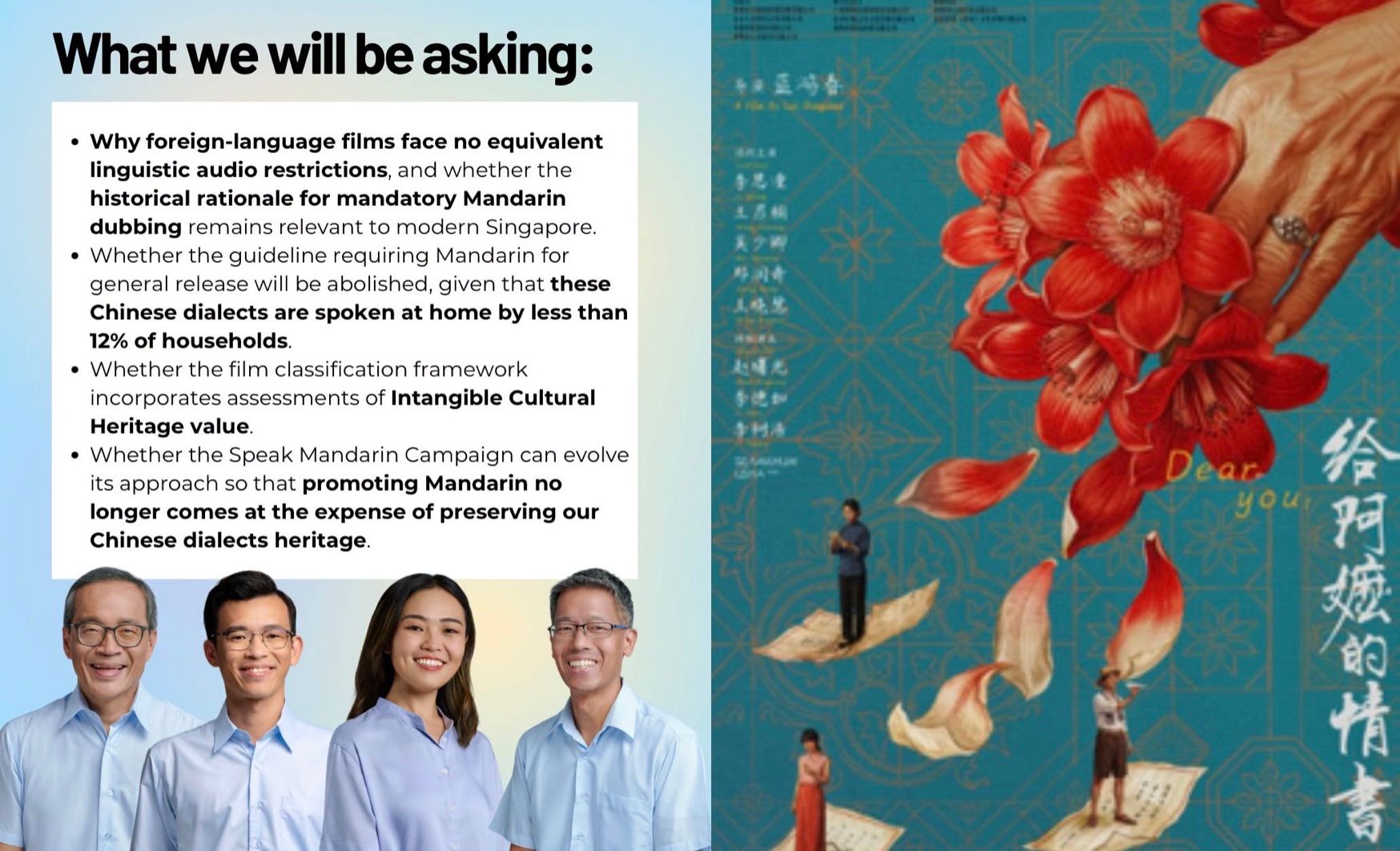

SINGAPORE: This week, some of the Workers’ Party’s Members of Parliament (WP MPs) will be raising questions in Parliament concerning Singapore’s language heritage, in the wake of the release of the Chinese film Dear You.
While the movie had been filmed in Teochew, it was largely released in Singapore in Mandarin, in keeping with Singapore’s policies. This caused a clamour for Dear You to be shown in its original language, and over a hundred additional Teochew screenings have been scheduled as a result of public demand. According to reporting from CNA, the total number of Teochew screenings is now at 272.
The Infocomm Media Development Authority (IMDA) had said that showing Dear You in Mandarin is aligned with its current approach, in which full-dialect movies are shown at festivals or niche events for viewers who want to see them in their original language, because this supports the bilingual policy aimed at promoting Mandarin as the main language for Chinese Singaporeans.
Several WP MPs have since commented on the issue online, including Aljunied MPs Pritam Singh, Gerald Giam, and Kenneth Tiong, as well as Hougang MP Dennis Tan.
In a Facebook post on Monday (July 6), the WP noted how in Singapore, the original language had been replaced in the movie, which is “centred on historical heritage.” And while it acknowledged that the IMDA has since adapted a “more flexible approach” to showing the movie in Teochew, the underlying issue is still there.
“Current guidelines still restrict full non-Mandarin Chinese language films from general releases, in view of the 1979 Speak Mandarin Campaign. In an era where foreign films face no such restrictions, shouldn’t our cinema policies evolve to protect our own Intangible Cultural Heritage?” the WP asked.
The opposition MPs will be raising the following questions:
Why foreign-language films face no equivalent linguistic audio restrictions, and whether the historical rationale for mandatory Mandarin dubbing remains relevant to modern Singapore.
Whether the guideline requiring Mandarin for general release will be abolished, given that these Chinese dialects are spoken at home by less than 12% of households.
Whether the film classification framework incorporates assessments of Intangible Cultural Heritage value.
Whether the Speak Mandarin Campaign can evolve its approach so that promoting Mandarin no longer comes at the expense of preserving our Chinese dialects heritage.
According to the post, Mr Tan, Mr Tiong, Mr Giam, as well as Non-constituency Member of Parliament Eileen Chong, will be speaking on the issue. /TISG
 Follow Google News
 Join us on WhatsApp
 Follow us on Telegram