

Summary
-
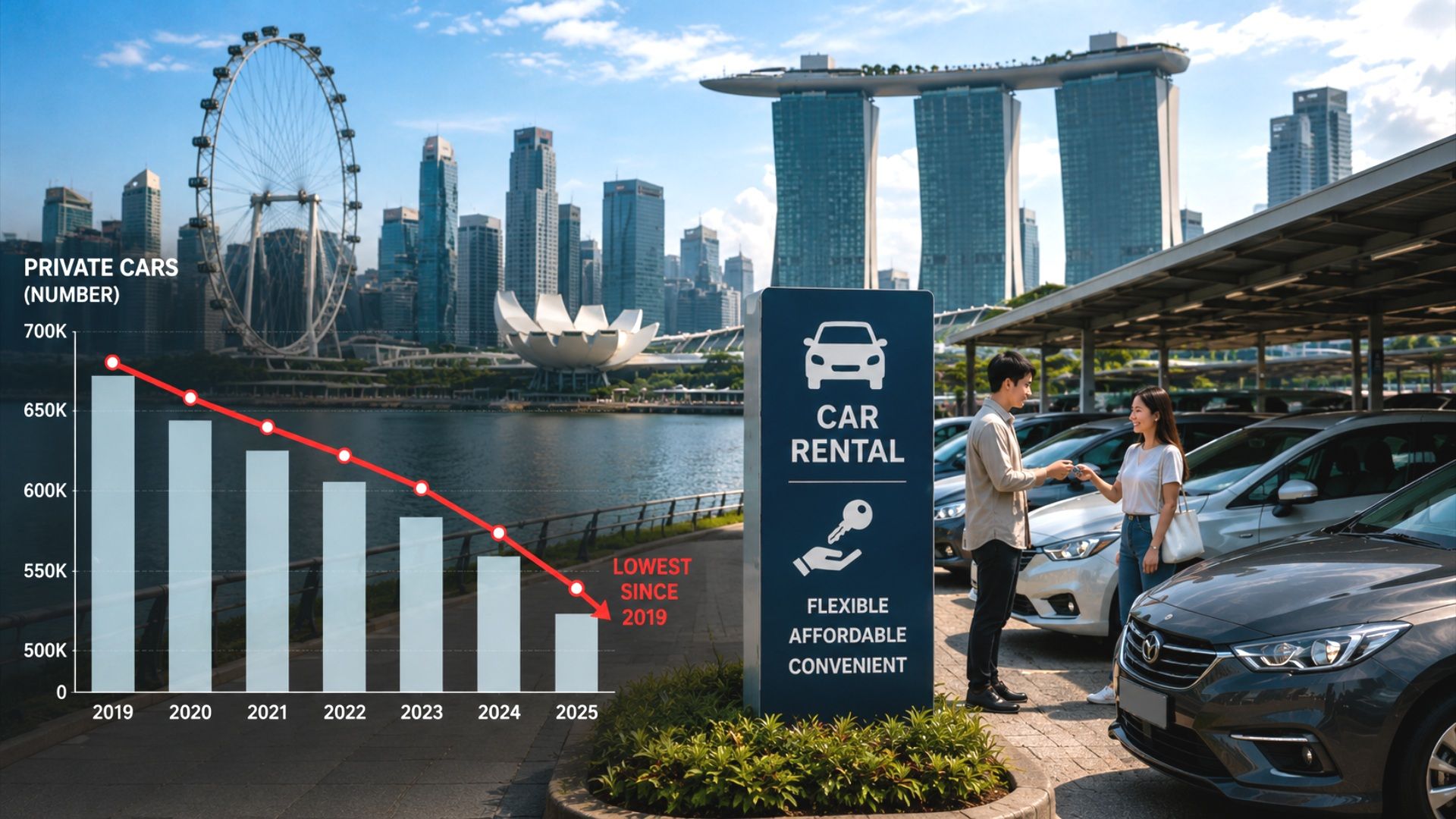
Singapore’s private car population fell to 516,237 in June, its lowest level since 2019, while rental cars reached a record 97,567 vehicles.
-
Private cars now make up 79 per cent of Singapore’s 653,442 cars, down from 82.5 per cent in 2021, as rental cars rose to 14.9 per cent.
-
COE premiums have ranged between S$102,009 and S$130,889 in 2026, encouraging more motorists to lease, share cars or rely on public transport instead.
SINGAPORE: Singapore’s private car population has dropped to its lowest level since 2019, while rental cars have reached a record share of the country’s vehicle fleet, pointing to a gradual shift in how some people get around.
Land Transport Authority (LTA) figures cited by Malay Mail (July 30) show there were 516,237 private cars at the end of June, compared with 97,567 rental cars. Private cars now account for 79 per cent of Singapore’s 653,442 cars, down from 82.5 per cent in 2021.
The rental fleet now accounts for 14.9 per cent of all cars, up from 10.5 per cent five years ago. While the numbers suggest more motorists are choosing access over ownership, the LTA said more data is needed before concluding that travel habits have fundamentally changed.
High car ownership costs are changing driving habits
One reason for this shift is that owning a car has become far more expensive.
Certificate of Entitlement (COE) premiums, which buyers must pay before registering a vehicle, have ranged from S$102,009 to S$130,889 this year. In 2024, they ranged from S$65,010 to S$116,002.
Walter Theseira, an associate professor of economics at the Singapore University of Social Sciences, said renting makes financial sense for people who drive only occasionally because ownership costs are so high.
The LTA said it will continue to track public transport ridership, point-to-point trips, and the use of shared cars and bicycles before drawing conclusions about whether Singaporeans are moving away from owning cars.
Car rental firms see demand but stay cautious
Demand for rental vehicles has risen, but operators aren’t rushing to expand their fleets.
Adrian Lee, president of the Vehicle Rental Association and co-founder of Tribecar, said rental companies have to balance rising demand against the risk of buying vehicles when COE prices are high.
If premiums fall later, operators could be left holding costly assets. Mr Lee also said younger users have become more comfortable treating short-term rentals as another mode of transport rather than owning a car.
The number of self-drive rental cars increased from 33,765 at the end of 2025 to 36,317 by June. At the same time, rental vehicles used for ride-hailing or chauffeur services slipped from 62,092 to 61,250.
Mr Lee said that drop may be linked to a rule introduced in February 2025. Under the rule, business-owned ride-hailing vehicles must stay within the industry for three years before they can be sold to individuals or converted into private cars. The LTA said the measure helps keep enough vehicles available for ride-hailing services.
Some families are saving more without owning a car
The trend is also showing up in household decisions. Sime Darby Auto Selection, Singapore’s leasing arm of Sime Darby, expanded its fleet by about 10 per cent over the past year to around 600 vehicles.
Managing director Christopher Chin said some customers are leasing cars while waiting for COE prices to ease before buying. Others have decided they don’t need a car at all.
Product engineer Gordon Tiang, 51, chose not to replace his car after its COE expired in 2025. He now relies on ride-hailing services when needed and saves about S$1,500 each month, with part of the money going towards family holidays. He said he misses the convenience of driving to social events and making trips to Johor Bahru.
Civil servant Joyce Lee, 45, and her husband also gave up their family car in 2025 after deciding their two sons were old enough to travel by public transport. After first using car-sharing for school runs, they switched fully to buses and trains. The family now saves between S$1,500 and S$1,800 every month, although their mornings start a little earlier.
More people are choosing alternatives to owning a car
The latest figures don’t show that Singaporeans are completely abandoning private cars, though. The LTA itself has cautioned against drawing that conclusion from one set of numbers.
What they do suggest is that more households are weighing cost against convenience. For some, renting a car only when needed makes better financial sense than paying the full cost of ownership.
That doesn’t mean private cars are losing their appeal. It just means people are becoming more selective about when owning one is worth it.
A practical transport system gives people real choices. If families can move comfortably between public transport, rentals, car-sharing, and ownership, they can choose what suits their lives rather than feeling locked into one expensive option.
 Follow Google News
 Join us on WhatsApp
 Follow us on Telegram