
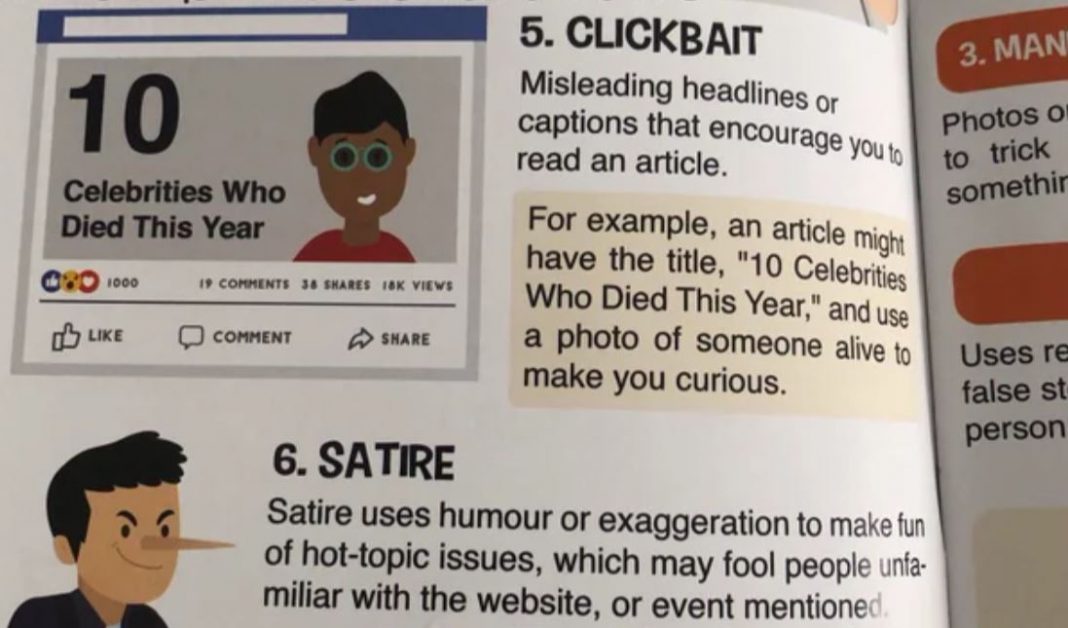

The Media Literacy Council (MLC), a Government-linked body, has said that it has stopped the distribution of a booklet that classified satire as a type of fake news to local schools after receiving intense backlash for branding a literary genre as fake news.
Revealing that it is currently reviewing the booklet, entitled ‘Get Smart with Sherlock’, the MLC told the Straits Times: “Our last dispatch to schools that requested the guide was in August and we have since stopped the distribution to schools.”
On Tuesday (17 Sept), Reddit user u/ongcs shared screenshots of the MLC-produced booklet – which is believed to have been circulated to students in primary and secondary schools – on social media. The netizen said that the booklet was handed to the Primary One students in his son’s class.
Branding satire as a type of fake news, the booklet claimed: “Satire uses humour or exaggeration to make fun of hot-topic issues, which may fool people unfamiliar with the website or event mentioned.”
Sharing several screenshots of excerpts from the MLC booklet, u/ongcs wrote: “My boy told me that, the teacher just handed them the book, without any further instruction. Neither did teacher read the book together with them, or explain to them. I don’t blame the teacher. Probably the instructions from the relevant organization is just “distribute to all the students”.”
The screenshots u/ongcs shared show that the booklet lists “confirmation bias, continued influence effect, illusory truth effect, backfire effect and echo chamber” as some of the reasons why people may fall for fake news. u/ongcs pointed out the difficulty of explaining such advanced terms to his 7-year-old son.
This is not the first time the MLC has branded satire as fake news. It first did so earlier this month through a post on its social media pages on six “types of fake news”. These were false context, imposter content, manipulated content, misleading content, clickbait, and satire.
The MLC swiftly drew intense backlash with netizens accusing the authority of spreading misleading information and asking it to retract the posts and issue an apology.
The organisation later apologised and promised to review its material. The MLC also admitted that Singapore’s anti-fake news law – the Protection from Online Falsehoods and Manipulation Act (POFMA) – does not extend to opinions, criticisms, satire or parody.
Days after the MLC apologised, Law and Home Affairs Minister K Shanmugam confirmed that “the suggestion that satire is covered by POFMA is erroneous.” He said:
“I can understand what the MLC was trying to say. But either they made a mistake, or it didn’t get said accurately…That is unfortunately not an accurate representation of POFMA.”
Screenshots of the MLC-produced booklet u/ongcs shared appear to show that the authority’s social media posts branding satire as a type of fake news was not a “mistake” as it was made out to be since the body made the same claim in materials that were circulated to impressionable students.
Media Literacy Council booklet distributed to Primary 1 students classifies satire as fake news
 Follow Google News
 Join us on WhatsApp
 Follow us on Telegram