
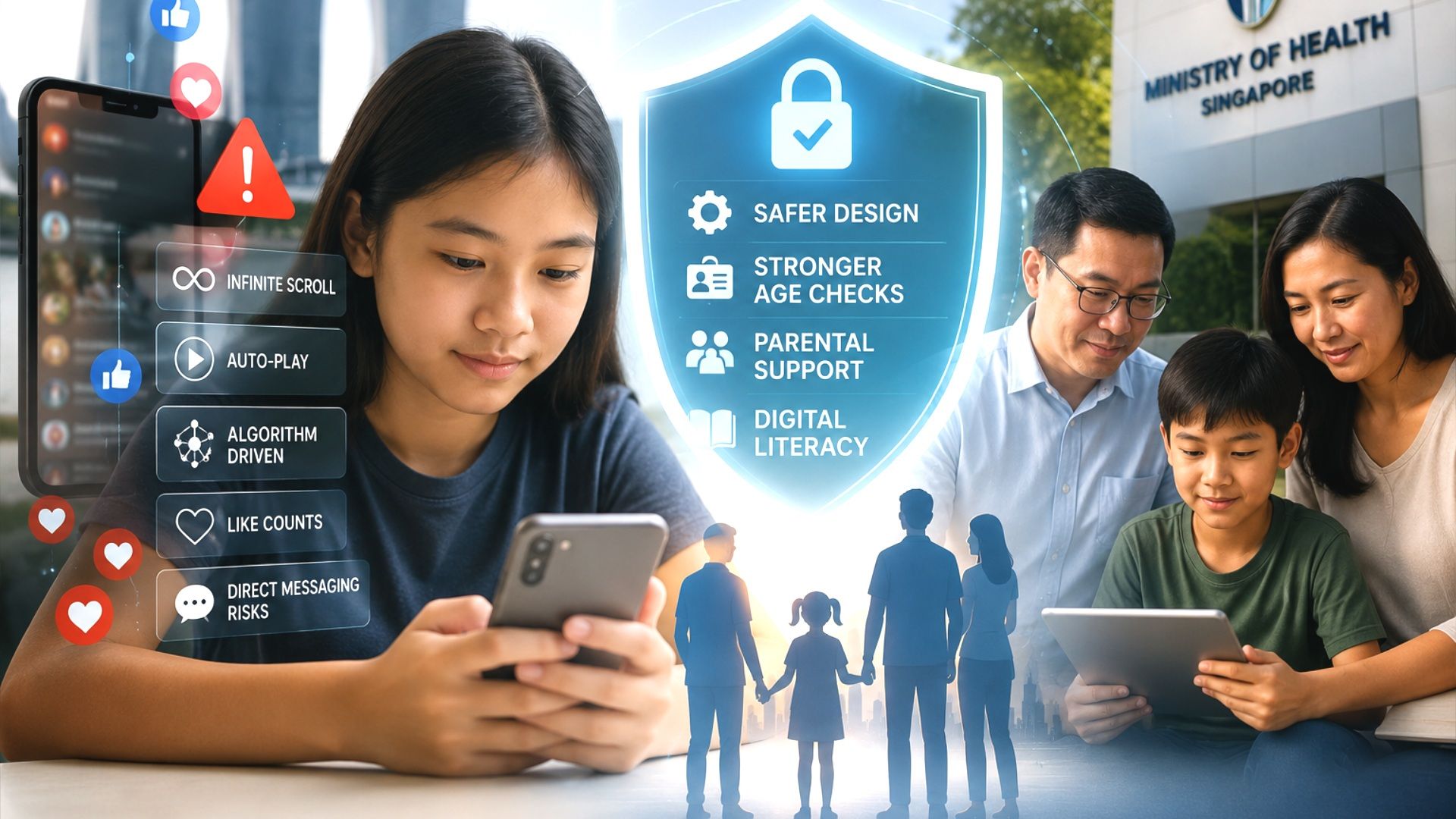

SINGAPORE: Singapore is better off making social media safer for young users than simply banning them from accessing it until they reach a certain age, according to a government-appointed expert panel.
The Ministry of Health (MOH) announced on Thursday (July 30) that the panel had submitted its findings after spending months studying the effects of social media on young people’s mental health.
Instead of recommending blanket age-based restrictions, the panel concluded that platforms should be redesigned to reduce harmful features while strengthening safeguards for children.
The panel also urged the Government to take a precautionary approach. While research hasn’t yet proven that social media directly causes mental health conditions, it found enough evidence linking problematic use to poorer well-being to justify acting now instead of waiting for absolute scientific certainty.
Harmful platform features should be the focus instead of blanket age bans
The panel said social media itself isn’t the direct problem. Instead, concern lies with platform features that encourage unhealthy behaviour or expose young people to risks.
Among the features highlighted were direct messaging, which may expose children to cyberbullying, harassment and unwanted contact from strangers. Anonymous or pseudonymous accounts were also identified as making harmful behaviour harder to trace and address.
The panel also pointed to infinite scrolling and autoplay functions, saying they encourage people to stay online far longer than intended by removing natural stopping points. Time spent endlessly scrolling can replace exercise, face-to-face interaction and other activities that support healthy development.
Algorithm-driven feeds were another concern. The panel found these systems can repeatedly push distressing or harmful content towards users, even when their original interest wasn’t related to such material.
Visible “like” counts and follower numbers were also singled out for encouraging constant comparison and validation, which may affect self-esteem, particularly among vulnerable teenagers.
Safer social media through platform safeguards
Several countries, including Australia, France, the United Kingdom, Malaysia and Indonesia, have moved towards raising the minimum age for social media access.
The panel acknowledged the intention behind those policies but questioned whether blanket bans are the best long-term solution. It noted that age limits don’t separate harmful and beneficial uses of social media and may encourage young users to bypass restrictions.
Instead, it recommended making platforms safer by design, reducing risky features, strengthening child safety measures and creating online environments that are more suitable for younger users from the outset.
The recommendation matches Singapore’s recent policy direction. Earlier this month, Minister for Digital Development and Information Josephine Teo said restricting access wasn’t the Government’s preferred starting point.
Minister of State for Digital Development and Information Rahayu Mahzam had also told Parliament in May that Singapore’s approach was intended to be more targeted than imposing a blanket ban.
Problematic use rather than screen time alone linked to poorer mental health risks
One of the panel’s findings was the distinction between excessive and problematic social media use.
Spending long hours online doesn’t automatically mean someone is at risk. Instead, the panel said persistent, compulsive or addiction-like behaviour shows a much stronger link to poorer mental well-being.
The figures in Singapore suggest this deserves attention. One in three teenagers aged 15 to 17 spend more than three hours on social media each day, while one in six people aged between 10 and 24 show signs of problematic social media use.
The panel found that problematic use has been linked to anxiety, depression, lower life satisfaction, body image concerns and unhealthy eating behaviours. It also noted that poor mental health and problematic social media use may reinforce each other over time.
Young people experiencing anxiety or depression may seek comfort online, only to become more dependent on social media while spending less time on healthier coping methods and real-world support.
Heavy social media use may also interfere with sleep, making emotional regulation more difficult during adolescence, a stage when many mental health conditions first emerge.
Panel urges stronger safeguards and shared responsibility of parents, schools and platforms
Beyond changing platform design, the panel recommended stronger age assurance measures so companies can better identify young users and apply age-appropriate protections.
It also called for greater support for parents and schools so children can build healthy digital habits, think critically about online content and better manage online interactions.
The panel said protecting young people cannot rest on governments or technology companies alone. Families, educators, healthcare professionals, community groups and platform operators all have a role in creating healthier digital environments.
Singapore has already introduced measures such as the Code of Practice for Online Safety, which requires designated social media services to reduce users’ exposure to harmful online content.
The Infocomm Media Development Authority also reviews the effectiveness of these safety measures, while several platforms have introduced stronger parental controls and youth accounts.
The expert panel’s recommendations will now help shape Singapore’s ongoing efforts to strengthen young people’s mental health and improve online safety.
Making digital spaces safer while teaching young people how to use them wisely is a more practical solution than assuming a single rule will solve every problem.
Building healthier online habits, alongside safer platform design, gives young people a better chance of enjoying the benefits of social media without carrying unnecessary risks.
 Follow Google News
 Join us on WhatsApp
 Follow us on Telegram