
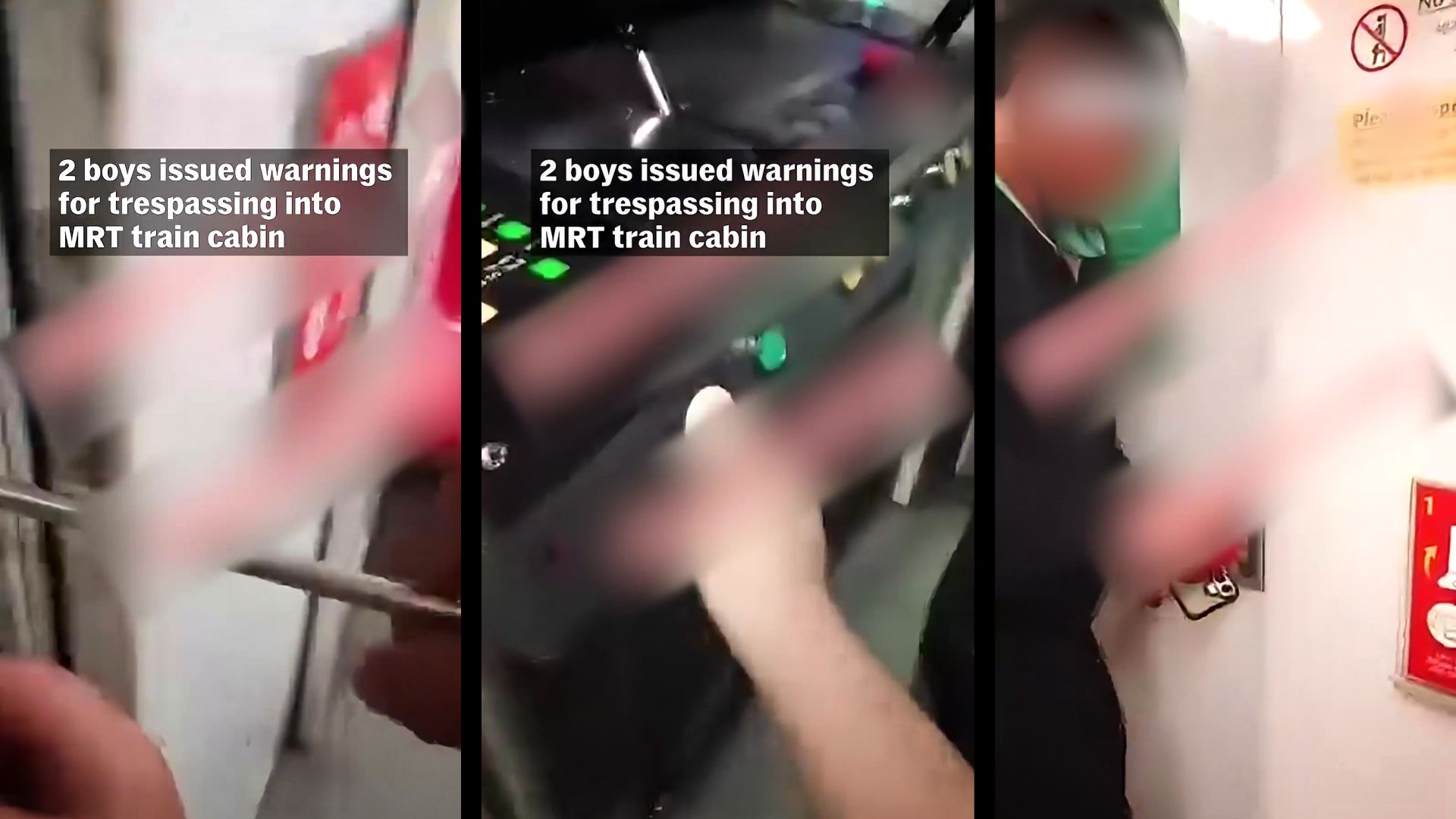

SINGAPORE: Two boys aged 11 and 12 have been given conditional warnings after they forced open a restricted cabin partition door on an MRT train and entered an area meant only for authorised staff.
The incident occurred on Feb 21 on a North-South Line train and drew public attention after a video circulated on social media over the weekend. The nine-second video showed the pair using a tool to open the rear cabin partition door before stepping inside and repeatedly pressing what appeared to be a white button on a control panel
Police completed their investigations before deciding, together with the Attorney-General’s Chambers, to issue conditional warnings rather than prosecute the boys, Channel NewsAsia (CNA) reported (June 30).
The train alarm was triggered immediately
SMRT said the boys’ actions triggered an onboard alarm. SMRT Trains president Lam Sheau Kai said the train captain, who was in the front cabin, alerted the Operations Control Centre as soon as the alarm went off.
Staff at the next station were told to investigate. By then, the two boys had already left the train.
Police said a report was filed on the day of the incident. After reviewing the case, officers consulted the Attorney-General’s Chambers before issuing conditional warnings for offences under the Rapid Transit System Regulations.
Restricted areas exist for safety reasons
SMRT said it takes unauthorised access to train cabins seriously because the spaces contain equipment not meant for public use.
The operator said forcing open cabin doors creates safety and security risks. It added that such behaviour can put those involved in danger and affect train services and other commuters.
Although the video lasted only a few seconds, the incident activated established safety procedures. The train captain notified control staff immediately, showing how seriously operators respond whenever restricted areas are breached.
A mischief that isn’t worth placing safety at risk
Singapore’s public transport network depends on commuters respecting safety rules, especially in areas where operational equipment is present. Interfering with those systems, even briefly, can create unnecessary risks for everyone on board.
Most people will never need to go near a train’s restricted cabin. Those barriers are there to protect passengers, staff and the rail system. A few seconds of curiosity or mischief isn’t worth placing safety at risk.
 Follow Google News
 Join us on WhatsApp
 Follow us on Telegram