
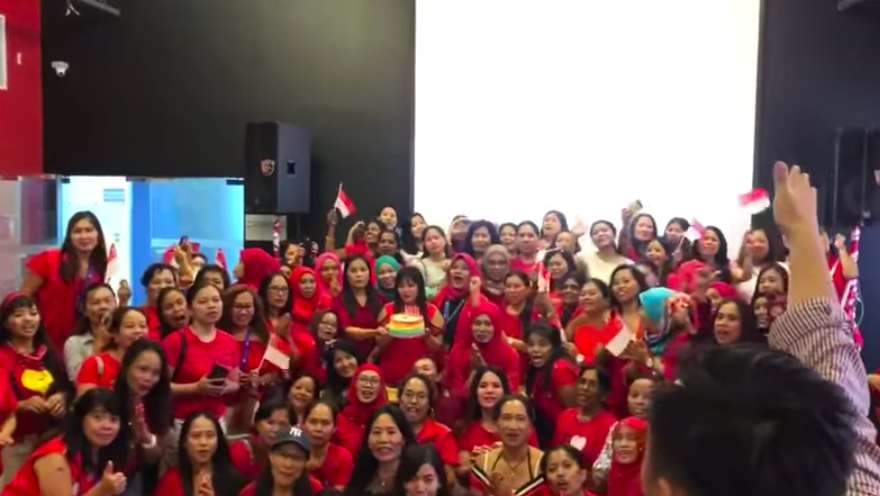
Facebook video screengrab: Foreign Domestic Worker Association for Social Support and Training - FAST
YouGov: Almost half of Singaporeans believe maids should be paid under S$600/month

YouGov’s research centered around what Singaporeans believe concerning the rights and living conditions of maids in the country, given that Singapore is one of the biggest employers of foreign domestic helpers in the South East Asian region.
According to Jake Gammon, the Head of Omnibus APAC at YouGov Omnibus, “With the sheer number of foreign domestic workers in Singapore, we wanted to find out what Singaporeans thought about the people taking care of their homes or their children. It appears that most are content with the current rights and quality of life for domestic helpers. What is interesting is how views vary between employers and non-employers of domestic helpers, with the latter thinking they deserve more time off.”
While there is no law that regulates a minimum wage for domestic helpers in Singapore, however, the research points out that the Employment of Foreign Manpower Act mandates that maid be given one rest day every week.
Sixty-eight percent of Singaporeans believe that one day off is sufficient, while 16 percent disagree. The remaining 16 percent say that one day a week is more than adequate.
Interestingly, YouGov’s research also shows that “Those that employ a domestic helper are more likely to find one rest a day week more than sufficient than those who do not (28% vs. 14%).”
At present, 17 percent, or one in every six households in Singapore employs a maid. For households with an income of over S$15,000 monthly, the percentage that employs a domestic helper is at 32 percent.
Domestic helpers in Singapore are mostly from Indonesia, at 44 percent. The others are from the Philippines, 26 percent; Myanmar, 11 percent; Malaysia 7 percent; and the rest (12 percent) coming from other nations.
Over a third of Singaporeans characterise the quality of life for domestic helpers in the country as good, while around half of Singaporeans would describe it as average, and a little above 10 percent say that it is poor.
Concerning the issue of abuse, 14 percent of Singaporeans have personally seen a domestic helper being abused, while almost 80 percent said they’ve heard of instances of abuse.
More than half of Singaporeans, or 56 percent, say that more can be accomplished in improving the lives of domestic workers, and for Singaporeans who have actually been witnesses to the abuse of a maid, four out of five Singaporeans say more can be done to improve their lives.
Newsletter
Get updates straight to your inbox
The research found that 55 percent of Singaporeans believe that there are adequate laws in the country that protect maids’ rights. But 31 percent are undecided on this matter, while 13 percent say that current laws are not enough to protect the country’s domestic workers.
The country’s foreign domestic workers number around 250,000, as of this June, according to the website of the Ministry of Manpower (MOM). -/TISG
http://theindependent.sg/mom-requires-employers-to-provide-direct-flights-or-travel-allowance-for-domestic-workers-after-employment-ends/