
The song that caught our attention

By Elias Tan
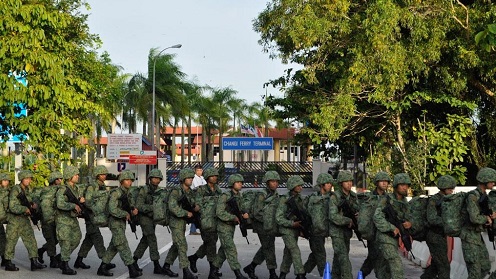
It started with a song. And that song, modified by the men-in-green and sung in cadence to boost their morale in the midst of an arduous march, contained “misogynist” lyrics that condone violence against women. Although most men laugh it off, female rights advocacy group Association of Women for Action & Research (AWARE) took serious issue with it.
The song, Purple Light, contained these lines: Booking out, saw my girlfriend / Saw her with another man / Kill the man, rape (or beat) my girlfriend / With my rifle, and my buddy and me.
What followed next was predictable. Both the Ministry of Defence and Singapore Armed Forces were quick to ban the verse. Thumbs up for Mindef and SAF for taking a tough stand on violence and rape.
The ban has caused quite a stir among the online community, with both men and women taking either Aware's side, or slamming the authorities and the advocacy group. One popular blogger, Darryl Kang, wrote in his blog entry that "it's just a song" and banning it is not going to do anything to prevent men from raping women.
Sure, there’s nothing wrong in modifying the lyrics of a song and singing it out loud, but singing about rape is another. Rape is a henious crime that should not be normalised. Normalising and trivialising rape only goes to show men's insensitivity and ignorance towards women.
Worse, singing it out loud, and on repeated occasions, desensitises a person to rape. It also conditions them into thinking that there’s nothing morally wrong with rape.
So guys, before you start singing the modified version of Purple Light, ask yourselves if you have ever thought about how rape victims suffered under the hands of their perpetrators; and the ordeal the victims’ family members, including their fathers and brothers, had to go through in order to seek relief and get their lives back on track.
Rape aside, the modified verse also glorifies another henious crime – murder.
While the outcome is clearly in Aware’s favour, it is unclear whether or not the banned verse is at all helpful in curbing the use of offensive language in army camps.
After all, it is common knowledge that most vulgar slangs and phrases disparage women.
What needs to be done is to discourage the use of vulgarities – Hokkien, Cantonese, even English – that degrade and insult the modesty of a woman in camps.
Officers and sergeants should also refrain from using swear words and vulgarities that describe their recruits' actions as "soft" and "female" when their intention is to tell them to toughen up and be a man.
Hey! Calling your men 'broken pussies' and 'smelly vaginas' is not going earn you the respect you crave and desire as a high-ranking officer.
Newsletter
Get updates straight to your inbox